STOP THE MAANGAMIZI: WE CHARGE GENOCIDE/ECOCIDE! CAMPAIGN
The Case for a Commission of Inquiry for Truth & Reparatory Justice
A demand made since 1787. The UK Government’s obligation stands.
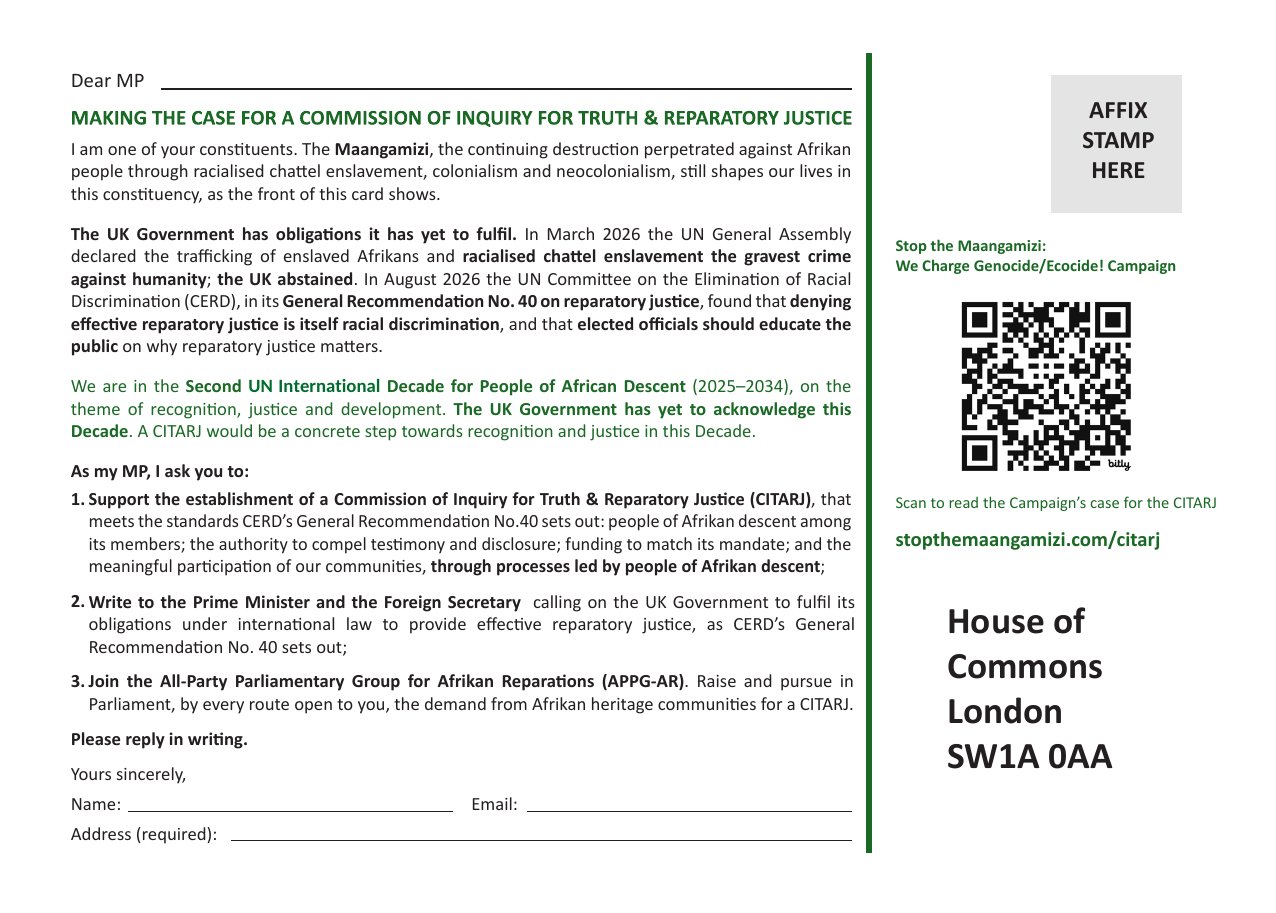
You may have reached this page from our postcard to MPs. Here is what the Commission of Inquiry for Truth & Reparatory Justice (CITARJ) is, why the UK Government is obliged to provide effective reparatory justice, and what you can do.
What the Maangamizi is
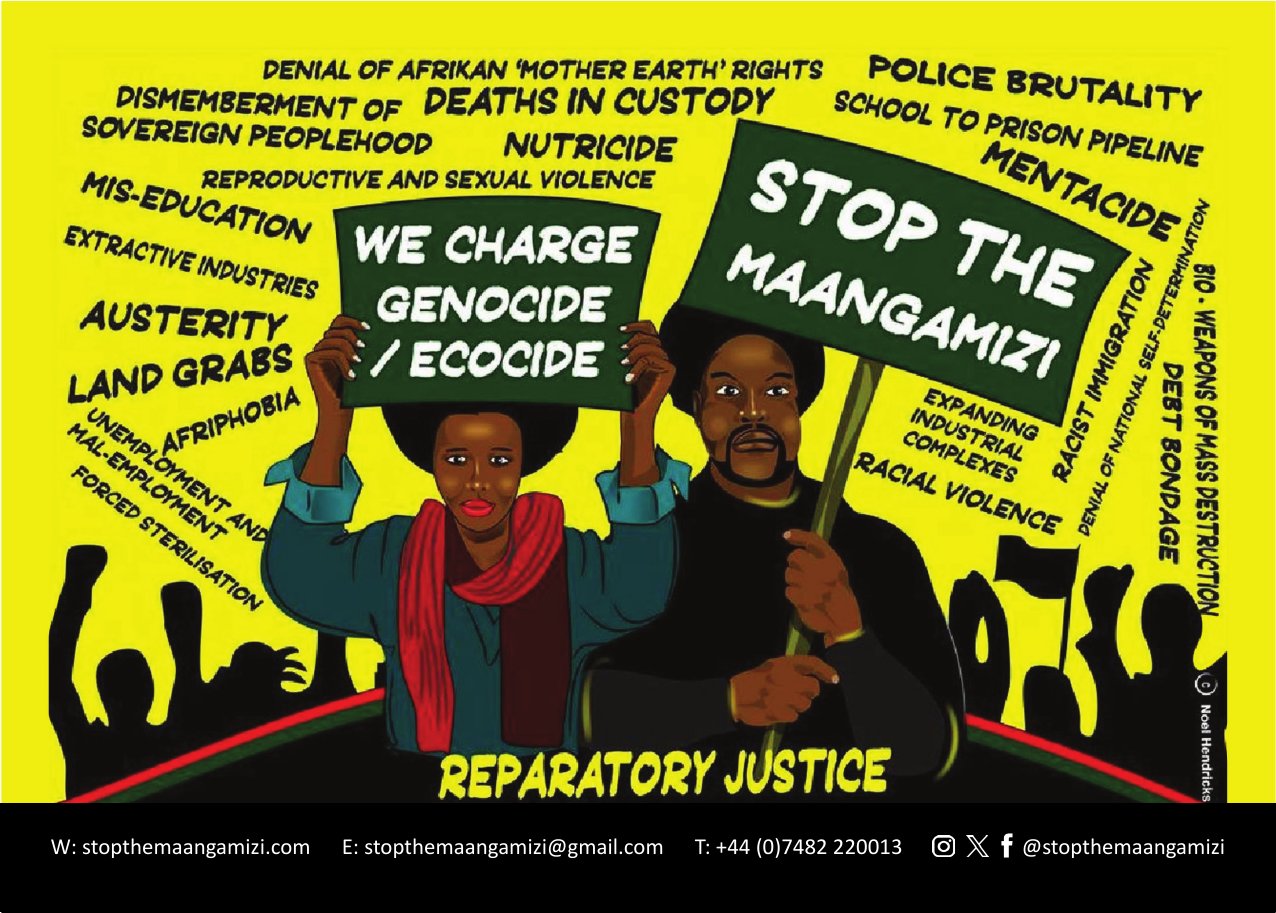
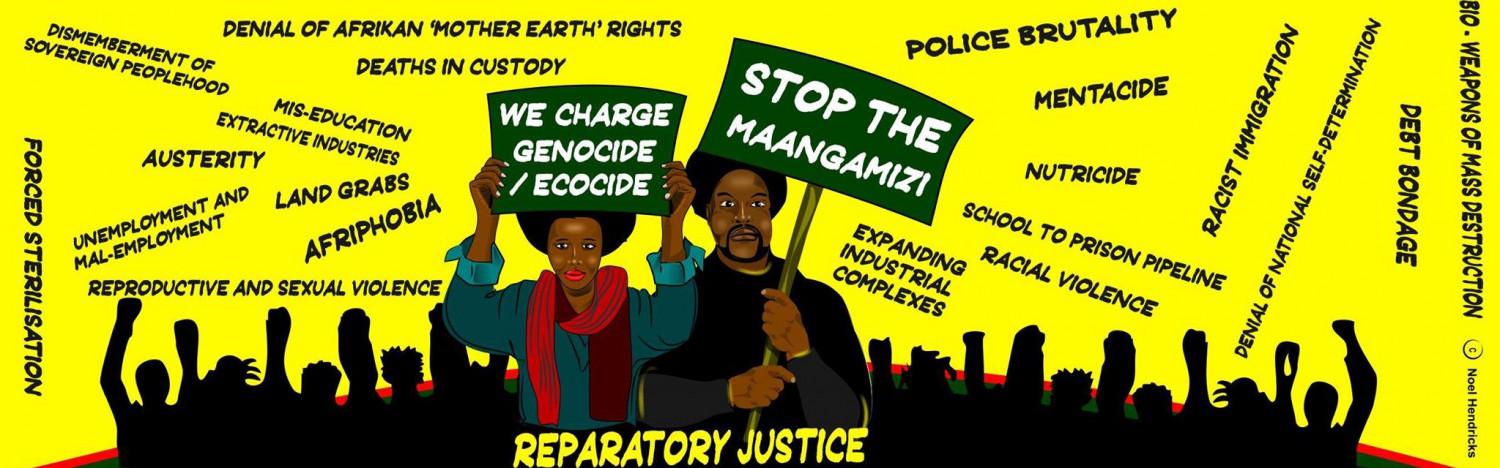
Maangamizi is a Kiswahili term, from the verb angamiza, to cause destruction, to utterly destroy, with the prefix amplifying it to massive destruction.
As the Maangamizi Educational Trust (MET) defines it, the Maangamizi is the ongoing system of deliberate and systematic destruction perpetrated against us as Afrikan people by those who enslaved, conquered and colonised us, through chattel enslavement, wars of extermination and conquest, colonialism and neocolonialism, encompassing genocide, ethnocide, ecocide, war crimes and crimes against humanity. It has three interconnected dimensions:
- the destruction of our personhood and peoplehood, so that many of us are estranged from our own Afrikanity and from our connection to our people;
- the destruction of our nationhood and culture, including the dismantling of our knowledge systems, the suppression and demonisation of our spiritualities, and the imposition of the colonisers’ languages, religions, names, ways of being and system of counting time;
- the destruction of our environments and ecosystems.
Professor Maulana Karenga popularised the term in ‘The Ethics of Reparations: Engaging the Holocaust of Enslavement’ (2001). The Pan-Afrikan Reparations Coalition in Europe (PARCOE) and the Stop the Maangamizi Campaign developed it in our own context.
What we are calling for
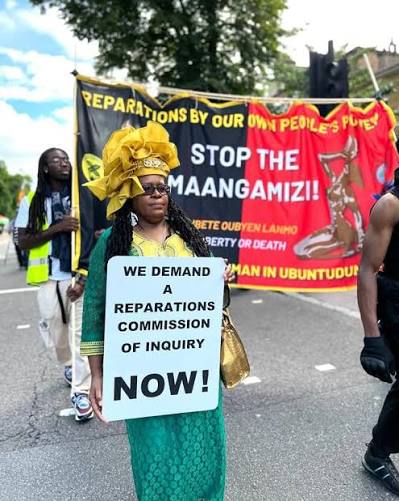
The CITARJ is the mechanism we are calling for, through which reparations policy recommendations and solutions are determined. One route is through Parliament, as an All-Party Parliamentary Commission of Inquiry for Truth & Reparatory Justice (APPCITARJ). Truth and reparatory justice sit together in one mandate, so a CITARJ’s work stays incomplete if it produces only a report.
What the CITARJ would do
- examine British participation in the trafficking of enslaved Afrikans and in colonial expansion, through formal colonialism, to ongoing neocolonial violence, and how institutions benefited;
- document continuing health, social, environmental and climate harms, including intergenerational trauma;
- examine Afriphobia, the racism directed at Afrikan people, structural as well as interpersonal, and ongoing discrimination against people of Afrikan descent;
- centre our own ways of knowing, including Ma’at, the holistic justice concept of our ancestors in Kemet (Ancient Egypt), and Ubuntu, umuntu ngumuntu ngabantu, a person is a person through other persons;
- recommend measures across the five pillars of reparation in the UN Basic Principles on the Right to a Remedy and Reparation (restitution, compensation, rehabilitation, satisfaction and guarantees of non-repetition), with cessation of the harm still being done coming first;
- support Afrikan Heritage Community Self-Repairs and Planet Repairs.
How it would work
Scope
Afrikan heritage communities in the UK and globally.
Composition
Community-nominated commissioners: elders, scholar-activists, legal experts and people with lived experience.
Participation
An Afrikan Heritage Communities Advisory Body shaping the mandate and priorities; community liaison locally and globally; and Maatzoezaduaras, circles in which we deepen in Maat, in right relationship with the living, the ancestors, Mother Earth and future generations, learn to be the reparatory justice change we wish to see, and prepare to give testimony.
Powers
To request documents, call witnesses and compel evidence, independent of the departments under investigation, with monitoring of implementation.
Testimony
Public hearings, private sessions, written submissions, artistic and cultural expression, and oral history.
Data sovereignty
Afrikan heritage communities, and all who give testimony, decide how testimony, records and archives are kept and used.
The UK Government’s obligations
- The International Convention on the Elimination of All Forms of Racial Discrimination, a treaty to which the UK is party.
- ‘General recommendation No. 40 on reparatory justice for the harms and continuing consequences of colonialism, the trafficking in enslaved Africans across the Atlantic and other routes, and racialized chattel slavery’ (CERD/C/GC/40) of the UN Committee on the Elimination of Racial Discrimination (CERD), adopted in August 2026. It calls on States to establish independent commissions that include people of Afrikan descent among their members, have the authority to compel testimony and disclosure from public and private actors, and are funded to match their mandate. It requires participatory processes that are State-funded and led by people of Afrikan descent. It finds that denying effective reparatory justice is itself a distinct form of racial discrimination, and that elected officials should educate the public on why reparatory justice matters.
- The UN General Assembly resolution of 25 March 2026 declaring the trafficking of enslaved Afrikans and racialised chattel enslavement the gravest crime against humanity, carried by 123 votes to 3, with 52 abstentions. The UK abstained.
- The Second UN International Decade for People of African Descent (2025–2034), on the theme of recognition, justice and development. The UK Government has yet to acknowledge this Decade. A CITARJ would be a concrete step towards recognition and justice in this Decade.
A demand with roots
Two routes, one demand
The demand on the British state stands: only the British state can fulfil what General Recommendation No. 40 requires of it. Alongside it, a People’s CITARJ can proceed now, convened with the International Social Movement for Afrikan Reparations (ISMAR) and the allied forces of the Peoples Reparations International Movement (PRIM). The two routes are interconnected and distinct, and the record a People’s Commission gathers builds the groundswell for, and informs, a parliamentary CITARJ. An inquiry run by the APPG-AR is a step on the parliamentary route.
What you can do
- Send the postcard to your MP, or write to them, calling on them to support a CITARJ that meets the standards General Recommendation No. 40 sets out, to write to the Prime Minister and the Foreign Secretary, and to join the APPG-AR and raise and pursue in Parliament the demand from Afrikan heritage communities for a CITARJ.
- Sign and share the Stop the Maangamizi Petition.
- Organisations: become a signatory to the Declaration of Support for the CITARJ, or a solidarity partner, resourcing the work, mobilising your constituency, contributing expertise or evidence, or backing it with parliamentarians.
- MPs: join the APPG-AR; raise and pursue in Parliament, by every route open to you, the demand from Afrikan heritage communities for a CITARJ; write to the Prime Minister and the Foreign Secretary calling on the UK Government to fulfil its obligations under international law to provide effective reparatory justice; and, as General Recommendation No. 40 sets out, educate the public on why reparatory justice matters.
Read more: ‘Towards a Commission of Inquiry for Truth and Reparatory Justice’ · General Recommendation No. 40 (CERD/C/GC/40)
Contact: stopthemaangamizi@gmail.com · www.stopthemaangamizi.com